She Sees Horses
by Reva Russell English

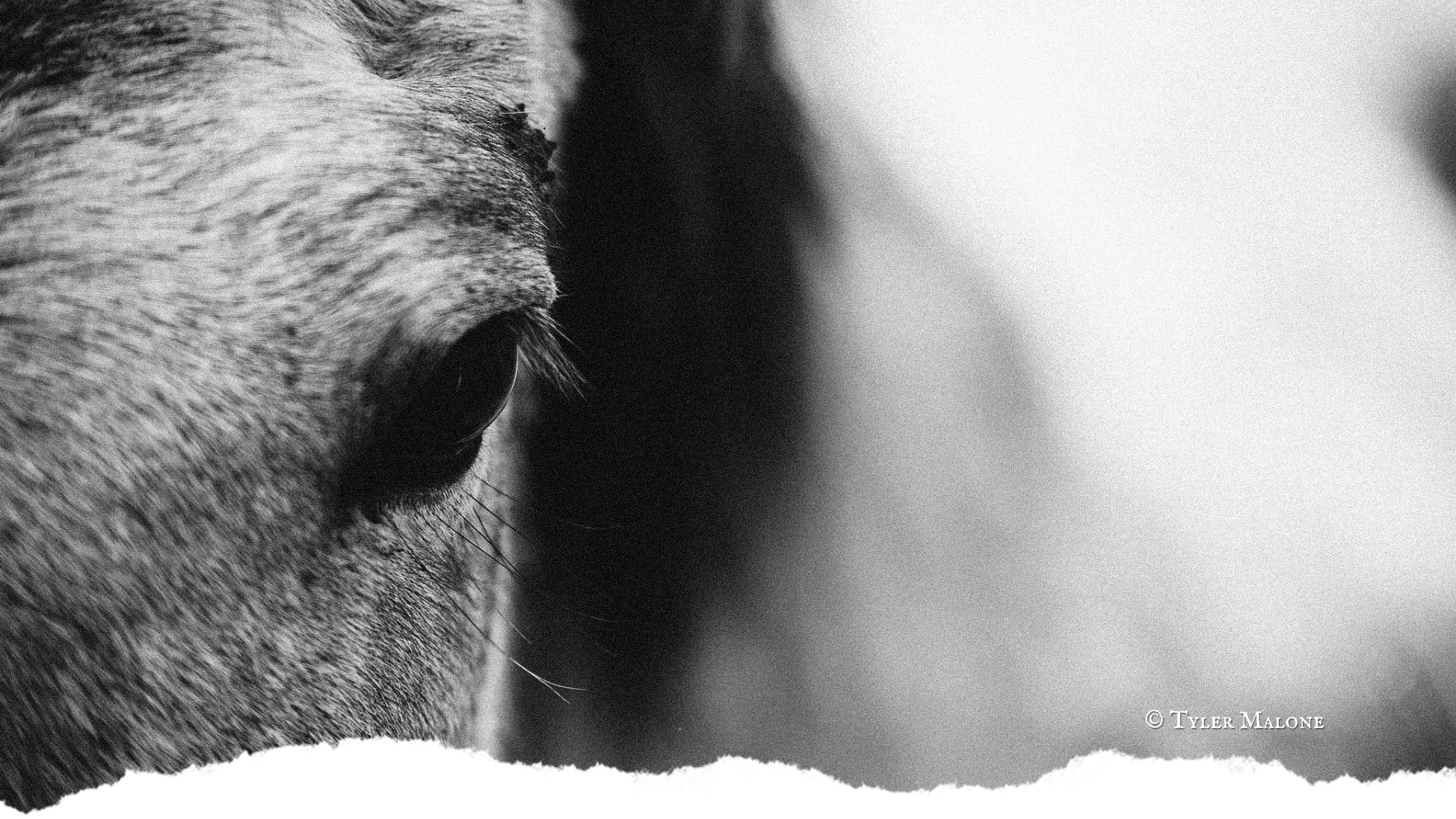
Teddy pulls the paper from its plastic sleeve and unrolls it. Presses the thin stack flat. Winces. Looks up. Through the large picture window, she sees horses, their heads moving up and down in the mist like oil derricks. Strange phantoms inside a morning that is itself a phantom. She turns back to the newspaper, but every word’s a cipher. She hears a new silence. The coffee pot has stopped dripping.
She puts down the paper and stands, hands flat against the table. While there’s been no hint yet today of death, she listens for it. Yesterday and the day before, she woke to shouts from the south pasture. Two ewes and a lamb before sunrise yesterday. A prize ram the day before. Last week the remains of an otter — where had it even come from? — and two more lambs. The dogs have signalled nothing, fought off nothing. So last night the farmhands began a patrol. She’d insisted they only take BB guns. What if they shot someone? she asked. The ones who knew English had shrugged but nodded. Caleb translated for the others, who shook their heads but did not meet her eyes.
She moves out from behind the table with slow, careful steps. It is only eight o’clock, too early to know if Caleb will or won’t knock at the back door before letting himself in. She hears him down by the smokehouse, the crack of his maul against wood like the snapping closed of a great mouth or the report of a rifle. She thinks of the ewes who have lost their lambs this past week. Thinks of the ewes who will lose lambs when the time to slaughter them comes in three months’ time. Thinks of the ewes they will also cull who did not conceive this year. The lambs will be butchered, packaged, and sold to restaurants and grocery stores, but the ewes will stay on the farm, smoked, then brined and hung. Even across the warm days of summer, the meat will keep, and they will all share in it, through the holidays and into the new year, exhausting the stores only when the time to cull came again. The maul lands, sends its shock of sound, goes silent.
She takes a second step, puts herself in motion. Hands gripping the backs of chairs and then the countertop edges, she reaches the coffee pot. She doesn’t really need to exercise such caution anymore, but each day’s beginning feels like a test, and she wants to pass by staying upright, by not needing help. She pours herself half a mug of coffee, spilling a little, then turns back toward the table without wiping it up. The return trip takes less time. She sits, her breath unexpectedly sharp and ragged. She takes a small, hot sip.
Smoothing the paper with her good hand, she tries again, and the letters form words beneath her gaze, “Livestock Deaths Remain A Mystery.” Two neighboring farms have lost calves and chickens to something, an animal that leaves no tracks, no scat. She begins to read out loud, her voice still hard to muster, as though some secret part of her must first fashion words in reverse before they’re allowed to be spoken.
It’s been almost a year since the stroke, since a vast, soft whiteness swallowed her then spat her out on Fat Tuesday, some three weeks later. She’d awakened in the hospital, the right side of her body immobile, her mind, desires, and questions trapped inside her mouth, unable to escape. The first word she’d said — percolate — had not been what she wanted to say. While a nurse ran to grab her a cup of coffee, she’d tried again to ask, “Where is my father?” It would be another week before the word father made it out from behind her teeth.
He’d moved the two of them here to Central Kentucky from West Texas when she was still a girl, memories of the oil derricks called forth by the horses from a time and place more like a dream, a dream of heat and drought and a mother. Among the Kentucky hills there was none of that, just horses, forest, loneliness, and wildflowers. Much had changed, but these remained, except no father now. Not anymore.
He was dead — she’d learned this once she’d been given paper and a pen, her left hand’s writing childlike but sufficient — had already been dead for two years. He’d gone peacefully, they told her. In his sleep. She’d tried to hunt down any recording of the service she’d reportedly organized but none existed. Her father had been dead and in the ground for two years, and the stroke’s power had removed it, had erased entirely the two years she’d already lived inside that reality and its lonesome knowing.
“Coffee fresh?”
She starts. Caleb is inside, standing next to the coffee pot, a mug already in his hand, his thick, graying eyebrows and lined face impassive as though he has not just asked a question.
She meets his eyes. Nods. Looks back at the paper.
“Got two surprise lambs this morning,” he says. He brings the mug up to his mouth and blows across the surface before taking a drink.
“Twins.”
He takes another sip and leans against the sideboard, one long leg bent.
“Sheila?” Teddy asks. Caleb laughs. It is a polite laugh.
“No,” he says. “I told you Sheila doesn’t look pregnant at all. Still don’t think she was bred this year.”
Teddy nods and does not look up. Sheila is her oldest ewe. A literal black sheep, Teddy bottle-fed her after her mother rejected her twelve years ago. It has made the ewe docile and affectionate. She has birthed twins every year since she was first bred — twenty lambs in total. She finds herself praying the ewe is bred, that she will not have to seem weak when staying Caleb’s hand when the time to cull comes. She knows what he will think of her, or rather she thinks she knows. She has never truly known what Caleb thinks. About anything.
“How’d the patrol go?” she asks.
Caleb grunts. “Nobody saw nothing,” he says. “We’ll do it again tonight.”
He stares out the window. A handful of seconds pass during which neither of them say anything. He is so still Teddy is afraid to breathe. She begins to count. At fifty, she exhales, and he turns back toward her.
“Thanks for the coffee.”
He refills the mug and steps outside, closing the door behind him too slowly to keep the cold from snaking in. Teddy takes a sip of coffee and watches as his form changes from full-color, three-dimensionality into an outline in the fog. He hops the fence as easily as he did thirty years before and passes by the horses. They raise their heads and step back. Then he is no more.

‘Among the Kentucky hills there was none of that, just horses, forest, loneliness, and wildflowers. Much had changed, but these remained, except no father now. Not anymore.’

Shouting. Strange lights. The sound of engines. Scent of smoke. Teddy opens her eyes and moves herself to the edge of her bed. She stands. The long, flannel pajama set she sleeps in is damp with sweat. Is she sick? She touches her forehead and face. Her head is hot. Her hands cold. She shivers and stands.
She makes her way out into the hall. Turns. Begins to walk toward the stairs, lifting her feet high to keep from catching the carpet and risking a fall. She reaches the top of the stairs. Stops. Thinks. Turns back around. She pushes off from the wall, then leans against it, alternating each push and lean with an accompanying step, so as to move more quickly. Passing back by her room and then the bathroom, she notices the shouts have changed pitch and volume. They are further away, but the engines sound close and getting closer.
Her father's bedroom door is open. She walks past the made bed and opens the closet. In the back left corner, she thinks, behind his suit coats and slacks. She steps in. Bends at the waist. Almost falls over. Standing back up, she steadies herself on the wooden closet rod, shaking. Inching sideways and dragging her right foot, she moves into the corner. She pants like an animal, mouth open, loud. She bends her knees and turns her face to the right so that the left side of her face is pressed against rough wool and tweed, the scent of her father’s deodorant and aftershave in her nose, three years old. She feels through the suit coats with her left hand until her fingers touch cold metal. She grasps the barrel of her father’s shotgun and pulls it toward her. Carefully, she stands, then lifts the gun until she can cradle the barrel across the crook of her stiff right elbow. She opens the breech and steps back, turning slightly to her right to catch the moonlight spilling into the closet from the bedroom windows. There is a shell in each chamber. She closes the gun and puts the safety on. Holding it down at her side, she inches carefully out of the closet. The smell of smoke is stronger. Now she can hear the sounds of animals: bleats, whinnies, barks, even the high yipping of the roosters. She thinks she hears Caleb yell.
When Caleb first came to work for her father, she was sixteen. He was twenty-six. His black hair had been longer then, his beard tinged with red, not gnarled with gray as it is now. She’d marvelled at his large eyes, the muscles in his forearms, the attention he could sustain when working with a horse. When she’d asked him to kiss her the morning of her seventeenth birthday, he’d walked away from her without a word, told her father what happened, and quit on the spot. She’d been mortified at his easy refusal and her father’s knowledge of what she’d done.
When he came back to the farm fifteen years later, she’d just ended a disappointing marriage and moved back into her childhood bedroom. Their affair was brief. Her body he’d handled with an expertise she enjoyed at first, a precision and knowing that seemed uncanny, preternatural. But over the two months in which she ventured over and over again into his bed in the small, two room cabin that served as the living quarters of the farm’s manager, his mastery became predictable and strangely cheapening. She felt herself little more than a machine that always responded according to its design when handled by a skilled operator. In his keep, she felt like the animals he broke or commanded: seemingly without secrets, without mystery, doing — both willingly and unwillingly — whatever he determined they would do.
She ended it by simply never going back to him. They hadn’t once spoken about it. For years, late at night, when a desire for easy pleasure asserted itself in her body and mind, she considered going back, certain that he would pick up with her where they’d left off without even a word. But she never did.

‘Now she can hear the sounds of animals: bleats, whinnies, barks, even the high yipping of the roosters. She thinks she hears Caleb yell.’

She makes it down the stairs. The light she leaves on above the stove is off. Running a hand along the wall, she finds the switch for the overhead light and flips it up. Nothing. A cold plum bob of fear strikes the surface of her bowels. She steadies herself against the wall a moment, then moves toward the back door, stumbling slightly when her right foot catches the leg of a chair. Eyeing her muck boots on the mat, she sets the gun down on the counter and transfers her weight to her left leg. She tries to maneuver her right foot into her boot, but each time she gets her foot in the opening and tries to push it down, the boot falls over.
For a moment she considers going outside in just socks, and then remembers her phone, upstairs on the nightstand beside her bed. She swears. Going back up the stairs would take at least ten minutes, and there was no guarantee anyone who worked for her would answer anyway. She bends down, and, with her left hand, pulls one boot and then the other back toward a chair and sits down. The scent of smoke is now accompanied by a slight haze in the air. She can no longer hear shouting or engines. There is only darkness and quiet and the sound of her heavy breathing as she struggles her way into the boots. From far-off now, sirens.
She stands. Orients herself so the line she needs to move in is straight. Makes it to the backdoor. Opens it. Steps back to take the shotgun from off the counter. She touches the safety. Still on. Outside, a light rain is clearing the smoke. She begins moving up the hill to the west, her right foot dragging some across the sodden earth. She wants to cry but doesn’t. She needs to get higher, so she can see whatever it is that’s on fire. To the north, the roosters start up again.
It had been Caleb’s idea to bring in sheep, and though her father had been reluctant at first, it had proven lucrative. Pastured lamb sold well at Easter and for every Eid. The sheep maintained pasture far better than the horses, and their vet bills, keep, and insurance costs were much lower. Along with the chickens, garden, and hoophouse, the sheep also provided food, which stretched employee money much further than at other farms in the area. As a result, they never struggled to hire or retain help.
Over the years, good decision-making plus a little luck made the farm, her father, wealthy. They hadn’t started that way. He’d purchased the land and his first two horses with the payout from her mother’s life insurance policy.
For years, they barely broke even, growing tobacco, then soybeans, then corn. After the sheep began to bring in consistent money, her father turned all his attention and money to thoroughbreds. Shares of stallions. Breeding rights. Real, live animals with storied bloodstock. Ten years ago, one of their mares birthed a Belmont Stakes winner. Then two yearlings sold for almost half a million each at the same Keeneland sale. Suddenly, they weren’t just rich. They were rich rich.
What she thought of it before the stroke she didn’t know, but after, when she learned that her father had left Caleb a twenty percent stake in the farm in his will, leaving her the remaining eighty, it had rankled her. Alarmed her. Not exactly partners, she still felt she had to consult him when making major decisions, but he did not extend the same courtesy to her. Twice he’d sold a horse without informing her, and though the prices he’d gotten had been more than adequate, his acting apart from her felt strangely sinister.
Mostly still bedridden at the time, apart from daily, exhausting bouts of physical therapy, she had confronted him. He offered no justification, just nodded, turned back to the fence he was mending and spoke a few words in Spanish just loud enough for her to hear. Mujer loca, no hombre.
After that, she’d changed the rules around purchasing on the farm, cancelled all the credit and debit cards, removed Caleb as a signatory on checks, instructed her lawyer that no transactions were to happen without her approval. For six months, Caleb spoke to her only through the lawyer or other employees. Weeks went by where she didn’t see him at all. Then, during the fall Keeneland meet, they had two horses win big purses. He knocked at the back door early in the evening on a Sunday night with a bottle of good wine and a bottle of excellent bourbon. They drank the wine and opened the bourbon. It grew dark. She wondered if he would go home. Then she wondered if he would stay the night. He fell asleep mid-sentence at the table, his head back, mouth open, teeth white and shining. She left him there like that, went upstairs, her head spinning from the alcohol, and fell asleep.
At some point in the night, she awoke to use the bathroom, still drunk. In the hallway, a figure. Large, bent over and sometimes on all fours, it moved between shadows like a shadow. She’d screamed and either fainted or passed out. She awoke at mid-day, her pants and the carpet beneath her soaked with urine, Caleb gone, the figure a distorted memory, a drunk’s dream, a crazy and lonely woman’s nighttime spectre.

‘After the sheep began to bring in consistent money, her father turned all his attention and money to thoroughbreds. Shares of stallions. Breeding rights. Real, live animals with storied bloodstock.’

She reaches the top of the hill. It is the equipment barn on fire, a quarter-mile away. A halo of orange rings it from the back as though a mouth to hell has opened up behind it. She turns to the south where the sound of sirens grows louder. She sees two, then three fire trucks turning up the drive. Where is everyone? The rain falls harder. It drips off her eyelashes, hair, and nose. Her pajamas cling to her skin. Her teeth chatter.
The dogs sound from near the chickens, and she grips the gun tighter. She will either have to go all the way around the front horse pasture — a walk, for her, of at least a half-hour — or convince her strange, unconvinceable body to go through or under or over the fence. Now, the roosters scream, and the dogs make a sound she’s never heard before, like a train, if a train were an animal. She squares up to face the sounds. Heads down the hill. Slips. Almost falls. The gun a sudden crutch. She makes it to the fence. Out of breath. Shivering.
There is so much rain. Her good leg begins to cramp behind the knee and at the hip. She bends down a little and drops the gun to the ground. Throwing her arms over the top fence plank so that her weight is held by the fence and her armpits, she kicks the gun under the bottom plank with her left foot.
She reaches her left arm down on the far side of the fence until her fingers can grab the underside of the middle plank. Carefully stepping both feet up onto the top of the lowest plank, she bends her knees, and with her weight on her right leg, jumps and swings her left leg up, her left arm pulling hard. It is just enough to get her left foot over the top plank. She is splayed across it, now. A spatchcocked chicken. She rolls and clears the fence, landing hard on her back. She cries out. The gun is hard and cold beneath her.
For a moment she lays there. Stunned. By where she is, by what she’s doing. The rain on her face is hot. No. The rain has stopped. She’s crying. Small whimpers form and die in the back of her throat. She is wet and cold. On her back. In the dark. Tears push up into and and out of her eyes like the overflow of some internal aquifer of pain and fear and self-pity. She knows she needs to find her way to her feet, that she needs to continue on to the chicken coops, that whatever it is that has happened, that is happening, she must confront and try to solve, but she feels too small, too broken and alone.
She thinks of her father, of when she last remembers seeing him, being with him: breakfast the day after Christmas three years prior. She can’t remember what they talked about or ate. But she remembers the winter light — pale and bright — and the feeling of being warm and safe, without worry.
She rolls her body toward the fence, but her right hand is too cold and stiff to grab onto anything. She settles again onto her back, fixes her left heel to the front of her right foot at the ankle and forces it back toward her butt, bending her knees as she goes. Feet flat, she rocks her knees side to side a few times, then throws her weight over and to the right, so that she’s on her stomach. She pushes up onto all fours, is about to lean back onto her heels to try and stand, when, out of the corner of her eye, she sees it: the bent over, four-legged thing from the upstairs hall the night she got drunk with Caleb, climbing over the fence and into the pasture with an almost human-like deftness. She chokes on air, wildly, grasping with cold fingers in the wet grass around her. Where is the gun? The thing moves like a void across the pasture, like a redaction, like nothing she has ever known or imagined.
Her right hand finds the gun. She cuffs it two, three times, bringing it as close to herself as she can, her stroke-addled fingers useless in the cold. Reaching across and underneath her body with her left hand, she grabs it. Falls over. The gun though. It is in her hand.
Time stops. Or rather, she finds herself outside of it. No, it is outside of her, and she watches it pass with a slowness she can see and feel. It is like being inside of a photo, the world outside marching on, observable, its effects not for her.
She hears some part of her still out there, out in Time, scream, but the mind she thinks with now is clear and unpanicked. Silent. She watches the thing turn and face her like the slow opening of a terrible door, sees it rise up like a bear on hind legs before dropping back onto all fours, head down, like a wolf, like a wolf in a flipbook drawn frame by frame to look as though it is moving toward her. It is moving toward her. She cannot see its features, but its movements register: graceful, precise, deadly. It heads her way at a slant, lit by the full moon. It is half a football field away and coming closer, its movements those of a slow-motion ape, now a cat stalking prey, now a man running who does not want to be seen. It slants down toward the middle of the field, and rises again like a bear, lifting its snout to test the air.
She pushes the butt of the gun down into the wet ground and pulls herself upright, her body buzzing and heated and moving so much faster than everything out there — out there in Time. She is close enough to a fence post to lean against it, just a little. So she does, stabilizing her right side. She sets her feet, left foot slightly forward of her right. She remembers she has never fired a gun left-handed, then pushes the thought away and out of where she is into a Time behind her or in front of her. She does not know which, but it does not matter. What happens next will determine whether or not she ever thinks a thought in regular Time again. She knows this. She knows that Time has become unreal and she with it. They will become real again together or never again.
She places the barrel of the gun across the crook of her right elbow and lifts it. A thin cramping rises in the back of her right shoulder, but she is used to pain, has been its companion this long, last year. She steadies the gun once the bead is in her eye, once the bead has found the thing coming toward her — down on all fours again, twenty yards away now — then reaches across the breech with her index finger for the cross bolt. She pushes the safety off. Selects the barrel. Her left hand as competent and deliberate as her right had once been. Conjoined twin. Dark mirror. Finger on the trigger, she inhales. She exhales.
She’d been at school when her mother died. A single-car accident two miles outside of town. Perhaps she’d swerved to miss a roadrunner. Perhaps she’d fallen asleep. They could never know. What Teddy did know was that her mother died around nine o’clock in the morning, but her father and the police and the EMTs and the coroner and the principal all let her go through the entire school day without telling her, knowing her mother was dead, knowing she didn’t know. She’d played at recess. Taken a math quiz. Eaten the lunch her mother had packed her. Walked home to a house full of crying people, some of them strangers.
She thinks of it now: her ignorance, how her smallness and youth and likely her gender had given them all some perverse permission to discount her, to shut her out from the realities of her own life, from the realities of life itself. As she stands braced against the fence — wet, small, alone — she still cannot wrap her mind around her mother’s absence from the world and her life, though it’s been more than forty years. It has passed in the blink of an eye. It has lasted an epoch.
For years after it happened, she’d been made to endure being told by well-meaning adults that her mother’s death and subsequent absence from her life — though difficult — would likely help her, make her more independent, more ready to accept hard truths in a world keen to deny them. In the face of such sentiment, she would nod. Force a smile. Under her breath, though, she would curse the speaker, wish upon them some awful and specific ill, so they could discover for themselves how nothing born of unrequitable pain yields value, how the learning of some things taints both learner and lesson, ruining both.
A curdled howl hacks at and splits the air. She keeps a bead drawn, but she feels now the rushing of the split air and knows she is leaving the still, soft point around which Time moves. She feels her heart slow down, then lurch, then steady. Whatever it is that’s in front of her is now close enough that she can see its teeth — sharp, white, many — and its tongue — long, dark, hanging. What is behind her is a fence post and loss and disappointment. A muddied scent of warm milk and feathers, of animal musk and shit, of rank and flowing blood reaches her nose. She does not know what is in front of her, but she knows she does not want to die. She steadies herself. Checks her aim. Squeezes the trigger. The recoil shimmers through her body. Her feet stay set. She keeps her aim. The thing in front of her falls.
Rises.
She pulls the trigger again and then again, but the gun does not respond. She panics now, lowers the barrel. She must open the breech, see why the right chamber won’t fire, but her good hand is shaking. Every part of her is shaking.
The animal in front of her moves with a steady deliberation, closing the distance between them. She opens the breech, but her eyesight has shrunk, and she cannot see inside it.
From inside the ground beneath her, a patterned thunder comes suddenly close, the vibrations growing and stretching out, down, and up until they also fill the air. She sees, from the pinpoint of what remains of her vision, flashes of shining, muscular color: brown, black, gray, white, yellow. She smells horses and wet earth, hears snorts and throttled, stinging neighs alongside the stiff, hollow thunk thunk thunk of a body being struck. She wills her breath down to a still too-rapid consistency, and her eyesight returns. Six horses, no seven, rise up and down in front of her, their hooves striking again and again the void that struggles to rise, that screams out, that snaps its teeth, that tries, but fails, to flee. It is unmoving, now, and flat against the earth — a piece of black carpet, a place where the world scrubbed off — but the horses do not pause. Engines and shouts and lights arrive. The horses gallop away. She collapses into someone’s held-out arms.
‘ She knows this. She knows that Time has become unreal and she with it. They will become real again together or never again.’
There are statements to make. Questions to answer. Questions that can’t be answered. The gun the police take as evidence, though the coroner has ruled Caleb’s death an accident. The gunshot wound had been superficial, and given how they found him: naked; blood under his fingernails and toenails; wool, muscle, feathers, blood, and bits of bone in his stomach and between his teeth; no one faults her for firing. The horses they hose off after samples are taken, the blood, hair, and bits of matter no one wants to name washed off onto the ground. No one is sure how the horses got out of their stables, only that they did, and that the dead man’s skull and spine were nearly destroyed beneath their hooves. In addition to Caleb, they lost thirty-six hens and four roosters. Two dogs. Sheila.
Teddy busies herself with repairing what has been broken, burned, or lost. She buries Sheila beside the house herself, next to a large forsythia. Decides they can get by without the dogs, since two remain. Insurance will pay for a new equipment barn and for most of what they lost in the fire. She buys more chickens, begins the search for a new farm manager. Hires someone. Remembers he will live in the cabin where Caleb once lived when he arrives next month.
She walks the mile from her house to the farm manager’s quarters. Since the night of the fire and Caleb’s death, her body has recovered almost all its mobility and ability. Only her speaking remains an occasional challenge.
The afternoon is warm, high sixties, with a meandering breeze that carries with it the smell of water, tractor exhaust, and the tulips that line the main drive. She can hear weed eaters, an occasional shout, a plane flying low overhead.
In the days following Caleb’s death, the police searched the cabin, but as far as she knows, they found nothing that would explain what happened. There was no one to call after his death. No relative to come and take away his things or attend the funeral she’d paid for and attended along with her employees, his co-workers. There had been no one to explain anything to. No one to seek explanation from. She steps onto the porch and hesitates. She has only ever set foot inside the place as Caleb’s lover. She tries the door. Unlocked. She steps inside.
It is just as she remembers, bright and uncluttered. Two large windows, partially covered by thin, white curtains at either end of the front room reveal fine specks of dust in the air. To the left is the small kitchen, no table. To the right, a sitting area with a bookshelf, some books, and an old television. She walks to the refrigerator and opens it, surprised to find it completely empty except for a case of Miller Lite. She walks to the bedroom in the back, the door propped open by a pair of Caleb’s boots. She notices for the first time the sound of flies buzzing and bumping against windows. She steps inside the bedroom.
It is darker here. A black trash bag partially taped over the one window flaps in and out, the window behind it broken. She walks over to it and pulls a corner down, revealing a spider web of mostly intact but shattered glass. One curved triangle of nothing lets in the breeze.
The bed she remembers is gone. So is the lamp beside it that she used to switch on in the early morning hours before the sun rose, so she could gather her clothes, put them on, and make it back home before her father awoke.
All that remains from those long ago nights is an old, wooden armoire that still holds Caleb’s clothes. Its doors are missing now, and she can see the short row of jeans and shirts hanging, his coveralls, a leather jacket she never saw him wear. Another pair of boots, a pile of socks, and neatly folded underwear line the bottom. In the corner farthest from the door is a blanket on the floor. She goes over to it, picks it up, drops it. It stinks of animal, is covered with coarse black and gray hairs.
She runs from the room, her right side keeping up with her left. Runs out of the house without shutting the door behind her. Runs though her legs are rubbery, her breath a saw that cuts her throat each time she breathes in, breathes out. She stops finally, bends over, hands on knees, wretches, almost throws up.
She will have someone on her staff get rid of it all: the blanket, the beer, the refrigerator, his clothes, the furniture. Let the new farm manager choose what fills it now. She will have the window replaced, the curtains thrown out. She will have it all repainted.
She stands. Steadies her breath. Starts to walk back home. In the distance, she sees horses.

Reva Russell English (she/her) is a writer, musician, and farmer/forager living in Lexington, Kentucky with her partner and child and a cat named Sir Pizza. Her work has appeared across a handful of journals, including Glass Mountain, Fiction on the Web, and The Canelands. Her first novel, Two Hearts, Two Mouths, is forthcoming later this Spring on Compass Press. To stay up to date on her publications and events, find her on Instagram, Facebook, or her website.
